Wilhelmina Delco: A Legacy in Motion
Wilhelmina Delco’s legacy is visible in the public institutions that carry her name: Austin Independent School District’s Dr. Exalton and Wilhelmina Delco Activity Center, Pflugerville ISD’s Wilhelmina Delco Elementary School, Wilhelmina Delco Drive on Austin Community College’s Highland Campus, and Prairie View A&M University’s Wilhelmina F. Delco Building. Each reflects the reach of a leader whose work has reshaped educational policy and political representation in Austin and beyond.
At 96, Delco’s life has encompassed decades of civic engagement, advocacy, and political leadership. Her journey from AISD’s Parent Teacher Associations to the Texas Capitol tells a story of a persistent commitment to education and public service.
Delco made history by winning a seat on AISD’s Board of Trustees in 1968. With that victory she became the first African American to be elected to a public office in Austin. She would help the district accelerate desegregation, and in 1973, sat on the founding board of Austin Community College. In 1974, after legislative redistricting in Travis County, Delco made history again as the county’s first African American elected to the Texas House of Representatives.
She’s a true public servant,” said Delco’s daughter Loretta Edelen, who credits her mother’s influence on the trajectory of her own life, as she also served on the AISD school board and is currently the community engagement director at ACC. “She looked out for those underserved populations, making sure everyone had access to the best in order to learn and achieve.”
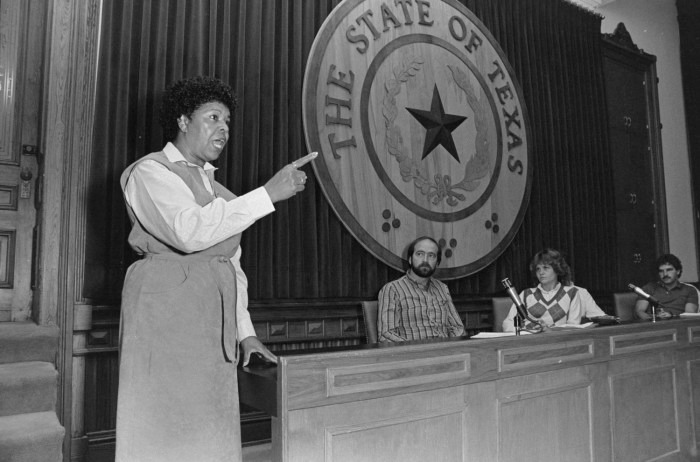
In her more than 20 years in the Texas House, Delco helped shape higher education policies across the state, becoming chair of the Higher Education Committee and the first woman to hold the position of Speaker Pro Tempore, the chamber’s second highest-ranking position. “She truly is a giant,” says Texas State Representative Ron Reynolds. “Her contributions still pay dividends today.”
Education and PTA roots
Delco was born Wilhelmina Ruth Fitzgerald on July 16, 1929, in Chicago. In her senior year at Wendell Phillips Academy High School she was student body president, and graduated as salutatorian before earning a sociology degree in 1950 from Nashville’s Fisk University. It was at Fisk that she met her husband, Exalton Alfonso Delco Jr. The couple moved to Austin in the late 1950s, and became significant figures in building access to education across the city. Her husband of over 73 years died in December.
A mother to four children, Delco was a leader in the PTA, serving as president at Sims and Allan elementary schools in East Austin. It was during her time at the PTA that Delco faced her first political challenges, confronting restrictions and fundraising fees that she felt unfairly burdened marginalized communities.
“Every time we wanted to do something that we thought would benefit our kids, we were told the school board said you couldn’t do that,” Delco said in a 2006 University of North Texas oral history interview. “I decided to run for the school board.”
Delco was elected to the AISD school board just two days after the assassination of Martin Luther King Jr. “I’ll always believe that the strong emotional pull of that convinced people that it was time to have someone on the school board who represented that heretofore unrepresented community,” Delco said in a 2001 Humanities Texas oral history interview.
Desegregation efforts
When Delco began her first term, AISD didn’t have a comprehensive desegregation policy. In August of that year, the U.S. Department of Health, Education, and Welfare notified AISD that its voluntary desegregation efforts did not comply with federal law. The board was asked to submit a formal desegregation plan.
One of the most controversial desegregation outcomes was the closure of L.C. Anderson High School in 1971. The integration of Anderson, founded as Austin’s first all-Black high school 80 years earlier, encountered resistance. The school was struggling to enroll white students. A district judge found the integration effort ineffective, and ordered Anderson to close. The school board voted to finalize the closure.
“I thought it was horrible to do that,” Delco told Humanities Texas. “Because to me it implied that the judiciary system had already made up its mind, and they went through the motions of giving this a trial but had no intention to give it the length of time that I think it should have warranted.”
Delco noted how the closure came at a significant social cost. With Anderson’s students dispersed across multiple campuses, families lost the networks that supported both academic and social life. Edelen says that her mother fought for the students to have the same educational and extracurricular opportunities that they had enjoyed in East Austin. Delco later played a key role in establishing the new L.C. Anderson High School on Austin’s northwest side, helping to preserve the school’s name and legacy.
Former Pflugerville ISD Board president Kenneth Thompson, who attended Austin public schools and later became the first African American elected official in Pflugerville, says Delco’s influence has been both personal and lasting. “I was one of those kids that she was advocating for,” he says, adding that naming Wilhelmina Delco Elementary School in her honor was a way to pass that example of equity and service on to the next generation.
Building higher education
While on the school board, Delco helped establish Austin Community College, and served on its founding board of trustees.
“I want to do whatever it takes to provide for the people in the Austin community the opportunity to widen their scope,” Delco told the Austin-American Statesman in 1972.
Delco believed that community colleges play an essential role in the lives of working adults, first-generation students, and communities of color who face financial and structural barriers to four-year universities.
ACC opened its first campus in the old L.C. Anderson High School building in September 1973 with 1,726 students. More than 50 years later, the college has expanded to 11 campuses across Central Texas, serving in excess of 70,000 students.
“Generations of students have grown because of her vision, courage, and unwavering belief in the power of education,” says ACC District Chancellor Dr. Russell Lowery-Hart. “Her legacy lives in every student who finds a pathway here. Her love for students continues to shape our college – and our region – and will for generations to come.”
The Texas House
Delco’s decision to run for the Texas House of Representatives was shaped by the limits she encountered on the school board. She explained to Humanities Texas that while local advocacy matters, many consequential decisions are made at the state level. She pointed in particular to a Supreme Court case that ruled that the state is responsible for equitable school funding.
While in the House, Delco used her school board experience to help shape policies pushing for fairer funding and stronger support for public institutions serving marginalized communities.
“Her focus was higher education,” says former Texas legislator and U.S. House Representative Craig Washington, who served with Delco. “She was very knowledgeable and passionate about what she was advocating for.”
Texas State Representative Reynolds says that Delco’s ability to build bipartisan relationships in the House was central to securing long-term funding for Prairie View A&M University. Through the appropriations process, Delco negotiated her belief in equitable funding into legislation, helping to incorporate Prairie View into the Texas A&M University System’s Permanent University Fund (PUF) at a time when Prairie View was locked out of that system and state investment in historically Black colleges and universities was significantly limited. The PUF funds allowed the university to expand academic programs and campus facilities, and grow into one of the nation’s leading HBCUs.
“The support was badly needed and long overdue,” says Washington, who graduated from Prairie View A&M in 1966. “It was gratifying to see her take leadership.”
A legacy in motion
In 1986 Delco was inducted into the Texas Women’s Hall of Fame, and in 1993 received the James Bryant Conant Award from the Education Commission of the States. In 1995 she retired from the Legislature, but continued her commitments to higher education and public service.
Delco chaired national education advisory committees for the U.S. Department of Education, served on the Texas Ethics Commission, taught as an adjunct professor at the University of Texas at Austin, and served as chair on the board of trustees at Huston-Tillotson University.
Despite her responsibilities over the decades, Delco still made time for her family, according to her daughter. “I never felt neglected at all,” says Edelen. “She was always there to support us.”
Delco’s legacy is one of enduring influence. Her name on campuses from elementary schools to colleges serves as a reminder of how community engagement, grassroots leadership, and persistent advocacy can have an impact.
“We mention her name because of the foundation she laid,” Reynolds says. “We’re trying to build on her legacy and stand on her shoulders.”
This article was originally published on www.austinfreepress.org.
Post a comment