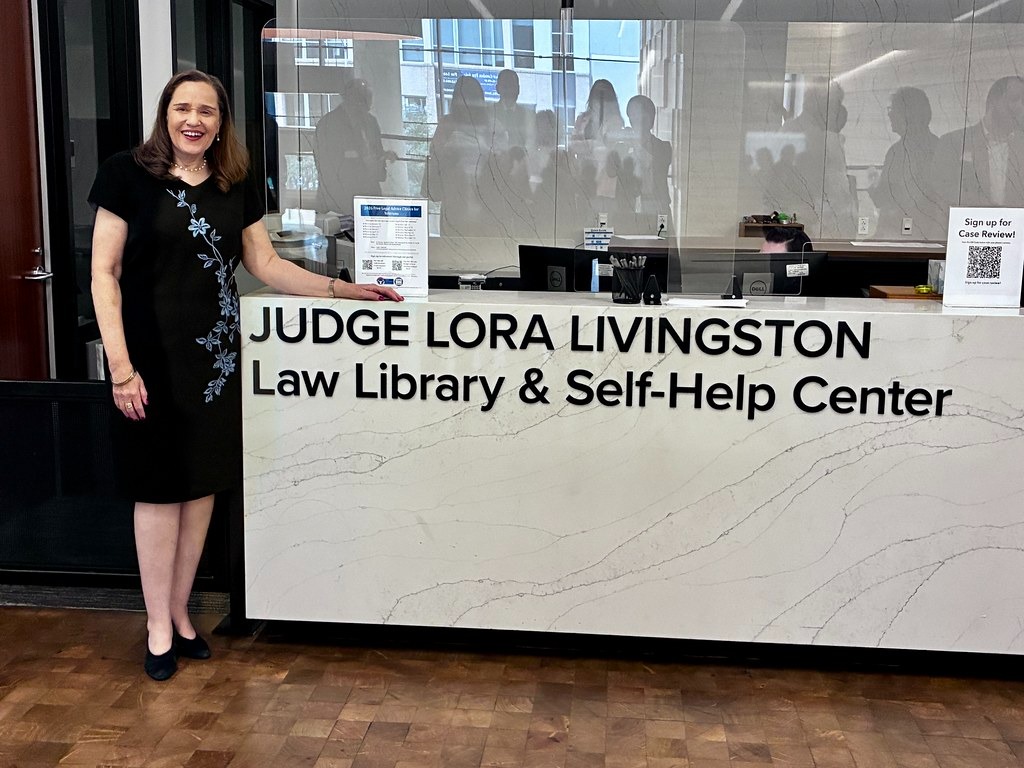
Help yourself: Judge Lora Livingston Law Library and Self-Help Center offers a path through the legal maze
When then-Travis County Associate Judge Lora Livingston returned from an American Bar Association conference more than two decades ago, she didn’t launch a major initiative or unveil a policy proposal.
Instead, she bought an easel.
Placed near the elevators in the lobby of the Heman Marion Sweatt Courthouse, the easel displayed daily court dockets so that people could figure out where they needed to go.
“One of the things that became obvious was that people who are representing themselves are literally lost when they walk into a courthouse,” Livingston said.
That easel reflected a philosophy that has shaped Livingston’s judicial career: making the legal system easier for regular people to navigate.
It’s a commitment that led Livingston to help establish the Travis County Self-Help Center within the Travis County Law Library to provide legal guidance and information for those representing themselves in court.
“The law library in Travis County has long been a well-established institution here,” Livingston said, “but my contribution really was in bringing the idea for a self-help center to fruition.”
In March, Travis County recognized Livingston’s work in expanding access to court resources by renaming the library and center the Judge Lora Livingston Law Library and Self-Help Center.
Livingston was honored. “I could not be more pleased and proud to have my name associated with the excellent, excellent work that is accomplished in the self-help center and the law library,” she said.
In-camera review
Before taking a seat behind the bench, Livingston imagined a career behind a camera.
As a student at the University of California, Los Angeles, she was interested in photography and storytelling. She envisioned traveling the world, documenting people’s lives.
That changed during a pre-law society meeting. There, Livingston heard Linda Ferguson talk passionately about working with the Lawyers’ Committee for Civil Rights Under Law. Ferguson spoke with force about how the justice system could make a difference in the lives of people who were struggling and voiceless.
“I thought, yep, that’s what I want to do,” Livingston said.
After law school, Livingston was accepted into a fellowship program she hoped would keep her in California or move her to Washington, D.C. Instead, in 1982 she was assigned to the Legal Aid Society of Central Texas in Austin.
Livingston found she loved the work, loved the people, and loved Austin. So she stayed. She worked in poverty law before moving into a private practice focused on family law, which ultimately led her to want to be a judge.
“What really feeds my soul most is the ability to try as best I can to find a solution that is just and right for all involved, not just for one side,” Livingston said. “Being a judge was the best way to accomplish that.”
After serving as an associate judge, Livingston was elected to the 261st District Court. She took office in 1999, becoming the first Black woman elected to a Travis County district court.
Navigating a legal maze
At the ABA conference that inspired her to buy an easel, Livingston learned about Arizona’s emerging self-help centers, which were designed to assist people who didn’t have a lawyer navigate the legal system.
She went to Phoenix to study the program, and returned determined to do something similar at the Travis County Law Library.
To figure out what was needed most, Livingston assembled a committee that included people from across the legal community: court staff, the private bar, the county clerk, district clerk, domestic relations office, and the law library.
Lisa Rush, the current director of the law library and self-help center, said the conversations revealed that almost everyone in the courthouse was fielding questions.
“Even the custodians were getting questions from self-represented litigants,” Rush said. “If they couldn’t get their question answered from one person, they would go to the next person.”
Those findings helped secure funding, and in 2001 a self-help center was established. The center developed step-by-step forms and guides to walk residents through the legal process. The goal was not to replace lawyers, but to give people enough information to navigate overwhelming legal procedures.
“Most of our patrons, this is their first time to be involved in the justice system,” Rush said. “You don’t want it to be scary and have legalese on top of it that doesn’t help anybody.”
Evolving help
The center’s early efforts focused on relatively straightforward legal matters such as adult name changes. Today, it provides resources on issues ranging from divorces and paternity matters to wills, landlord-tenant disputes, and expunctions, which destroy or seal certain criminal records.
Rather than operating as a separate office, the self-help center is housed within the law library. When people representing themselves enter the library, librarians and reference attorneys help them locate legal forms, understand court procedures, and connect with legal resources, while also providing them access to the library’s research materials and public computers.
Rush said the library and center now serve roughly 30,000 people annually.
Meanwhile, Livingston’s original easel has evolved into information desks, improved signage, and interactive digital kiosks in the Travis County Civil and Family Courts Facility, which opened in 2022.
The law library and self-help center is located just beyond the security checkpoint on the second floor, Rush said, so that people could find help immediately rather than being shuffled from office to office.
Livingston’s commitment to making the courts easier to navigate extends well beyond one program, she added.
“If I say to you, she cares about people and she cares about justice, I have just done her an injustice,” said Rush. “Because it doesn’t capture the depth of it.”
A continuing vision
Although Livingston retired from the 261st District Court four years ago, she still serves as a senior judge. In that role, she hears cases by assignment, filling in for judges who are unavailable and relieving crowded dockets.
Travis County Commissioner Brigid Shea said Livingston’s vision continues to guide residents through the judicial system.
“She’s a remarkable example of a true public servant,” Shea said. “Literally hundreds and hundreds of people are benefiting from her vision.”
This article was originally published on www.austinfreepress.org.
Post a comment