Aiming for the stars: Former NASA flight director speaks at observatory launch party
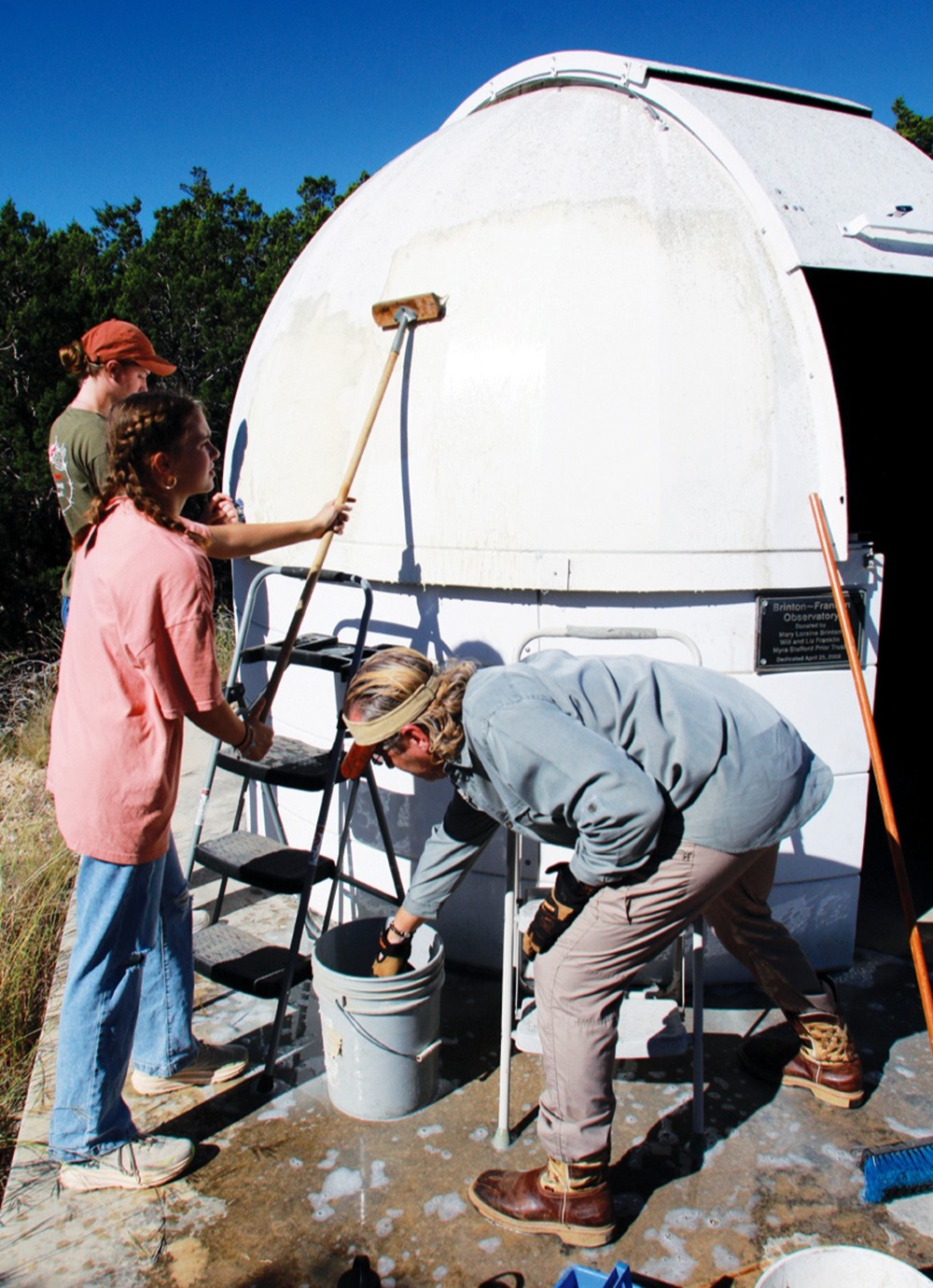
The Hill Country Youth Ranch marked the start of a major observatory renovation Sunday with a launch event that connected local youth to the history—and future—of space exploration.
The Brinton-Franklin Observatory, located on the ranch’s Big Springs campus in Leakey, is expected to be unveiled by Oct. 22 following significant upgrades to its equipment and capabilities.
“We’ll now be able to repair the dome motor and assembly, rewire the electronics and install internet lines from the telescope so our kids — and even NASA, believe it or not — can dial in and see the open skies from our Big Springs campus,” said Tye Phelps, HCYR donor relations officer.
The event featured a lecture and Q&A session with Gerry Griffin, a former NASA flight director who worked on every crewed mission in the Apollo Program, followed by a screening of “Apollo 13.”
Griffin’s team was scheduled to oversee the moon landing of Apollo 13 before an oxygen tank explosion forced the mission to abort, turning it into a dramatic effort to safely return the astronauts to Earth.
“It was fun, despite the bad times,” Griffin said about the formative early days of space exploration. “For one thing, we did something that hadn’t been done. We were all... young and didn’t know we couldn’t do it, so we just went ahead and did it.”
FROM EARLY MISSIONS TO THE MOON
Griffin began his career after earning a degree in aeronautical engineering from Texas A&M University and serving as an officer in the U.S. Air Force. He later joined the space program as a systems engineer and flight controller before becoming a NASA flight director in 1968.
His work spanned the earliest days of human spaceflight, including Project Gemini and the Apollo missions that would eventually land astronauts on the moon.
“The robotic part of it. We call that unmanned space flight,” he said. “It’s played a big role in everything that has helped to enhance human space flight. Things like satellites are necessary. They’re the trailblazers for human exploration. They help teach us what to expect.”
As the Apollo Program progressed, each mission built toward the goal of reaching the moon.
“Our goal for human space flight was the moon. It’s the closest friend we have in our solar system, and it was almost like it was just waiting for us to see if we could put a man on the surface,” Griffin said.
That goal became reality with Apollo 11 in July 1969, when Neil Armstrong and Buzz Aldrin became the first humans to walk on the moon.
“There wasn’t a lot of excitement in the control center when they landed, because we knew we had to get them home, which had never been done from that far away,” Griffin said.
LESSONS IN LEADERSHIP AND EXPLORATION
Reflecting on his time at NASA, Griffin emphasized the importance of leadership and trust.
“The leadership is really what lead us to do what we did. You’ve got to put decisions down where the expertise is,” Griffin said. “Don’t bring everything up to the top. Trust people to get things done."
Today, space exploration includes both government agencies and private companies such as SpaceX and Blue Origin, which are working alongside NASA on projects like the Artemis program.
“I don’t think you could do this today. It’s just not in the DNA of the people who are trying to get there,” he said.
The Artemis missions aim to return humans to the moon for the first time since 1972 and lay the groundwork for future missions to Mars.
“We haven’t had a human on Mars yet, but we will,” Griffin said. “I think human space flight will remain the domain of governments, but with international partners, and part of those partners are the commercial guys.”
LOOKING AHEAD FOR LOCAL YOUTH
For the Hill Country Youth Ranch, the observatory renovation represents more than a facility upgrade—it’s an opportunity to inspire the next generation.
“Any time that you can get hands-on experience is where you really learn,” Griffin said. “The time that these kids will have with the telescope in the observatory will definitely give them a leg up. It gives them opportunities that they won’t have anywhere else.”
The Hill Country Youth Ranch provides a safe, loving and life-enhancing Christian environment for children and young adults who have suffered severe trauma from abuse or neglect.
For more information on the Hill Country Youth Ranch or to make a donation, visit https://youth-ranch.org/ or call 830-367-2131.
This article was originally published in The Kerrville Daily Times.
Post a comment